Icon of report

research report

Summary of Interviews with California Metropolitan Planning Organizations About Senate Bill 375 and the Sustainable Communities Strategies

Publication Date

October 1, 2020

Author(s)

Clay Kerchof, Jazmin Amini, Laurel Matthews, Matthew Thompson

Abstract

In July and August of 2020, a research team of four graduate students from UC Berkeley’s Department of City and Regional Planning conducted interviews with directors and other high-level staff representing several of California’s metropolitan planning organizations (MPOs) to gather information on the achievements and challenges associated with the implementation of SB 375. Key takeaways from this effort include: 1) MPOs are not requesting additional authorities or oversight of local land use decisions; 2) MPOs use funding as “carrots” to incentivize local plans to align with regional goals, and many MPOs desire more discretionary funding and priority-specific funding; 3) some MPOs want to focus on greenhouse gas (GHG) strategies, such as telecommuting, active transportation, and technological advancement, in order to meet their greenhouse gas emission targets; 4) MPOs want the State to develop policies in ways that acknowledge distinct planning nuances and economic and geographic contexts across regions; 5) the process of developing and submitting regional plans to the State for review is staff-intensive and technically complex for MPOs, which takes away from the agencies’ capacity to focus on implementation and other work; 6) Senate Bill 375 has empowered MPOs to consider more deeply the relationship between land use and transportation; and 7) as a result of Senate Bill 375, there is now increased communication and engagement between the MPO and a broader set of stakeholders

Icon of report

research report

Best Practices for the Public Management of Electric Scooters

Abstract

This research project evaluates the social, environmental, and safety impacts of shared electric scooters (e-scooters)’ through a literature review, a nationwide scan of state and local laws and regulations, and a case study of Oakland’s experience with e-scooters, including an analysis of the city’s user survey and the own in-depth interviews. E-scooters offer an enjoyable, low-cost travel option, but are used mainly by young, affluent, white males. To improve equity, cities are requiring e-scooter rental companies to serve low-income and minority communities, and some further mandate that a share of the e-scooters accommodate people with disabilities. E-scooters are quiet and produce no tailpipe emissions, but their cumulative environmental impact depends on their manufacture, useful life, disposal, and use. In early applications, rental e-scooters survived less than a year. Some 30-50 percent of e-scooter trips replace short auto trips. Cities and states can improve e-scooter safety by encouraging helmet use, offering rider training, limiting speeds, improving pavements, managing parking, and calming traffic.

Icon for misc.

dataset

Consumer EV Data: California

Abstract

Please reach out to the project Principal Investigator for more information.

Icon of megaphone

policy brief

Overcoming Transportation Barriers to Health Care Access During the COVID-19 Pandemic

Abstract

Delaying or forgoing health care can lead to serious health consequences. Since the onset of the COVID-19 pandemic, American health care utilization has dramatically shifted, and many aspects of transportation systems have been disrupted. In response to new and emerging health risks, economic hardship, and access challenges related to COVID-19, at least two in five adults had delayed health care by July 2020.1 Both directly and indirectly, the pandemic has amplified transportation challenges, which are a well-documented barrier to health care access. Public transit service schedules have been cut, reduced-cost shared-ride programs have been disrupted, and new concerns have arisen about the safety of relying on rides from people outside one’s household. Job loss, health insurance interruption, residential moves, and changes in how and where health care is offered have also influenced how people travel to care.COVID-19’s effects on transportation to health care are likely to disproportionately impact certain groups, with important implications for health equity. To understand the transportation needs of different populations during the pandemic, this report reviewed the literature across seven health care needs that are overrepresented among people with transportation challenges and/or amenable to transportation interventions. This included: (1) dialysis for end-stage kidney disease, (2) prenatal care, (3) cancer care, (4) mental health care and substance use treatment, (5) health care for people living with disabilities, (6) health care for people with multiple chronic conditions, and (7) preventive care.

Icon of megaphone

policy brief

Vehicle Ownership Trends and Their Implications for Transit Ridership

Publication Date

September 1, 2020

Author(s)

Andrew Schouten, Evelyn Blumenberg

Abstract

Since 2000, vehicle access has increased substantially in California. Between 2000 and 2018, the state added approximately 5.6 million automobiles, roughly one vehicle for every new resident. During the same time period, the share of households in California that do not own a car declined, dropping from 9.5% to just over 7%. Because automobile ownership is an extremely strong determinant of travel behavior, the increase in vehicle availability has important implications for transit use. Individuals living in households with at least one vehicle take the vast majority of their trips by car and have a relatively low likelihood of using transit. Those living in households without cars, by contrast, are a core constituency of transit systems. While less than 7% of households in California do not own a vehicle, these households take approximately 37% of all transit trips in the state.Even prior to the COVID-19 pandemic, transit ridership in California had fallen. From 2014 to 2018, California lost more than 165 million annual boardings, a drop of more than 11%. The close relationship between car access and transit use thus raises a crucial question: has the growth in automobile ownership in California over the past several years depressed the state’s transit ridership?

Icon of megaphone

policy brief

The Eighty-Five Percent Solution: Is Crowdsourcing Speed Limits the Best Approach to Traffic Safety?

Publication Date

September 1, 2020

Author(s)

Brian D. Taylor, Mark Garrett, Yu Hong Hwang

Abstract

Setting appropriate speeds on roadways requires balancing the economic and social benefits of higher vehicle speeds on one hand, against the greater safety, environmental, and human activity costs of fast-moving traffic on the other. While drivers and commercial shippers typically favor faster limits, those living, walking, biking, or playing in proximity to roads often want slower limits. The most common method for setting speed limits, however, leaves it to drivers to collectively decide how fast is too fast. According to the U.S. Federal Highway Administration (FHWA), most places in North America set speed limits using the “85th-percentile rule.” This long-established standard calls for observing the speeds of free-flowing traffic on a roadway without posted speed limits, and then setting the limit at a 5 mph increment above or below the speed at which 85% of vehicles travel. So, for example, if 85% of drivers on a particular road are observed to travel at 43 mph or less, the speed limit would be set at 45 mph.

Icon of megaphone

policy brief

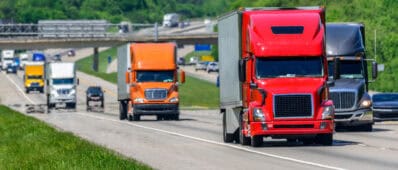
Will COVID-19 Worsen California’s Truck Driver Shortage?

Abstract

The trucking industry serves as the backbone of the nation’s economy. In 2018, approximately 3.5 million truck drivers were delivering over 70% of all freight tonnage in the United States, generating close to $800 billion in gross revenue annually. While 3.5 million truck drivers represents a significant number of jobs, it is not enough to satisfy demand. The trucking industry suffers from a chronic shortage of drivers. Nearly 70,000 additional heavy-duty tractor-trailer drivers in the United States were needed at the end of 2018, according to the American Trucking Associations. And COVID-19 has brought new challenges that may amplify or dampen the driver shortage and in turn impact supply chains. For example, what if a small percentage of long-haul truck drivers became ill? Would it cripple the industry? Would it significantly delay the delivery of essential medical supplies and equipment? This policy brief summarizes a study from UC Irvine exploring the challenges imposed by COVID-19 on truck drivers, looking at past crises, and interviewing academic and industry experts.

Icon of report

research report

Leveraging the California Highway Incident Processing System for Policy and Research

Abstract

There are two official sources of data on traffic incidents in California: 1) the Statewide Integrated Traffic Records System (SWITRS), intended to include incidents leading to injury or death; and 2) the California Highway Patrol (CHP) data on Caltrans’ Performance Measurement System, PeMS. Traffic safety researchers rely heavily on the post-processed SWITRS database, which provides only some crucial information about crashes. In 2015, the Road Ecology Center at UC Davis developed a third method to collect all incident data that appear on the CHP real-time incident-reporting website (https://cad.chp.ca.gov/). These data are assembled into a database called CHIPS, for California Highway Incident Processing System. Analyses indicate that the number of incidents recorded in a given period is similar in CHIPS and SWITRS but lower in Caltrans’ Performance Measurement System. Also, many SWITRS records (e.g., 36% in 2018), but no CHIPS records, lack or have inaccurate location information on incidents. Through case studies, the research group examined three ways that CHIPS can be used to support data and policy analysis. This report proposes future pathways for creating a more integrated system for collecting and analyzing crashes.

Icon for peer review journal article preprint

published journal article

Designing Robo-Taxis to Promote Ride-Pooling

Abstract

Robo-taxis (automated vehicles operating in a ride-hailing model) have the potential to improve mobility while reducing traffic, emissions, and energy use. However, such outcomes depend largely on increasing riders per vehicle. Public policy that incentivizes industry to design robo-taxis to support ride-pooling may be critical to achieving positive outcomes. This research reviews current shared automated vehicle designs and literature related to potential consumer risks and benefits of ride-pooling in robo-taxis in order to articulate potential design solutions to promote pooling.

Icon for peer review journal article preprint

published journal article

The Usual Policy Levers Are Not Engaging Consumers in the Transition to Electric Vehicles: A Case of Sacramento, California

Abstract

We investigate whether the population of all vehicle-owning households has already considered purchasing a plug-in hybrid (PHEV) or battery electric vehicle (BEV). First, we explore purchase engagement and find that even in the city where the Zero Emission Vehicle (ZEV) policy originates (Sacramento, California) few consumers are engaged with PEVs, few have considered purchasing one, and many cannot name a single BEV or PHEV presently for sale, and many are not aware of incentives to buy or advertising of them. Next, we model purchase consideration using ordinal logistic models to understand correlations of purchase consideration with awareness of incentives, advertising, or ride and drives; whether respondents know how PHEVs and BEVs are fueled or the name of one for sale, have sought information on PHEVs and BEVs or have spoken to an owner; the density of chargers and PHEVs and BEVs in respondents’ home location; and respondent socio-demographics. We do not find any relationship between common engagement strategies (e.g. advertising, incentives, and ride and drives) and whether consumers have already considered buying a PHEV or BEV. Those who have considered purchasing a BEV or PHEV have done so due to prior interest.